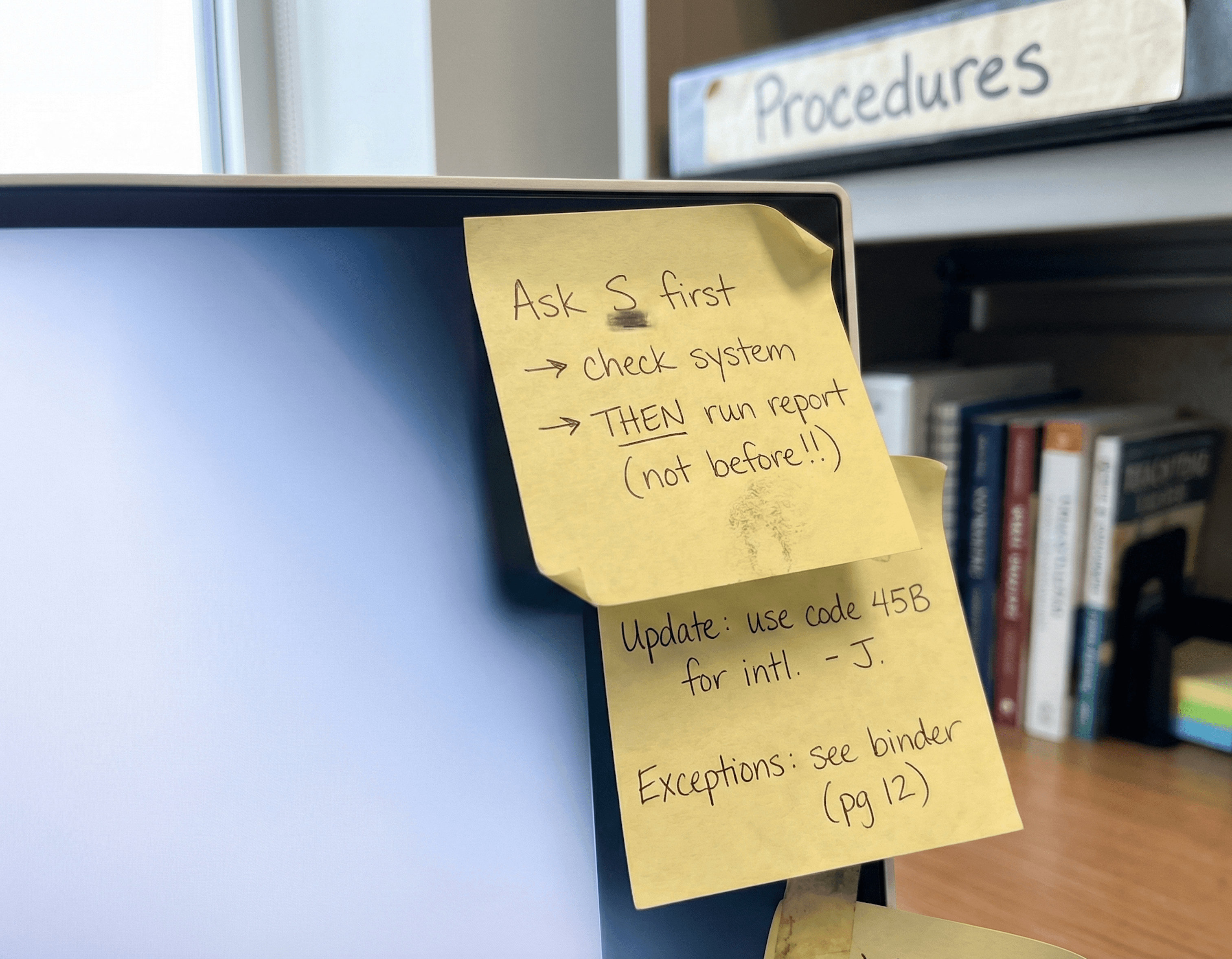
The system was supposed to carry you.Instead, you're carrying it.

You built this company by moving fast. Now your best people fill gaps the system leaves behind.

They're not complaining. They're compensating. And the better they are, the less you see it.

Start a Conversation

You already know.

If two of these are true, the problem isn't your people. It's your infrastructure.

Every decision takes three meetings and still nothing happens.

Your team has the authority on paper. But every real decision circles back to you. Not because they lack capability—because the system never defined who decides what. You're not a bottleneck by choice. You're a bottleneck by design.


Your best people are bottlenecks because everything requires them.

Your operations manager knows where every file lives, how every system connects, which vendor contacts actually pick up the phone. She trained no one. If she gives two weeks' notice tomorrow, six months of institutional knowledge walks out the door with her.

Three departments solved the same problem three different ways last quarter.

At 8 people, everyone had the same context. Now information fragments. Different people have different pieces. People form narratives based on incomplete information. Trust frays when people are operating on different versions of reality.

The same strategic initiatives have been "almost ready" for six months.

You're not bad at strategy. You're drowning in reactive work, and your strategic initiatives are too big and amorphous to make progress on in the gaps. Important keeps losing to urgent—not because you don't care, but because urgent has a deadline and important doesn't.

Your team writes docs that nobody reads, so they stop writing them.

Documentation projects are separate from real work—and real work always wins. Your experts are too busy doing the work to write it down. The wiki goes stale. Nobody trusts it. Everyone just asks the expert anyway.

Growth is harder than it used to be.

The playbook that got you from 1 to 5 million stopped working somewhere around 8. You're doing more of what used to work—more calls, more campaigns, more hustle—and getting less. The effort goes up. The results stay flat.

Every decision takes three meetings and still nothing happens.

Your team has the authority on paper. But every real decision circles back to you. Not because they lack capability—because the system never defined who decides what. You're not a bottleneck by choice. You're a bottleneck by design.

Your best people are bottlenecks because everything requires them.

Your operations manager knows where every file lives, how every system connects, which vendor contacts actually pick up the phone. She trained no one. If she gives two weeks' notice tomorrow, six months of institutional knowledge walks out the door with her.

"Your best people aren't failing. They're filling gaps the system leaves behind."

You outgrew your infrastructure.

At $3M with 8 people, everyone had the same context. Communication was a hallway conversation. Decisions happened in real time.

At $12M with 35 people, everything breaks. What used to be obvious now requires explanation. What used to be one handoff is now five. Your playbook stopped working around 30% ago.

This isn't a failure. It's physics. Every successful company hits this wall. The question is whether you recognize it before your best people start leaving.

What you think are "people problems" are structure problems wearing human faces.

Structural problems have structural solutions.

After the system holds

Your team decides without you

You stopped being the bottleneck three months ago. Now you hear about outcomes, not approval requests. When your ops coordinator faces an edge case, she checks the decision framework and moves forward.

Someone takes a vacation and nothing breaks

Your ops lead is in Portugal for two weeks. The person covering her isn't texting questions every morning. The handoff doc exists. The process runs. New hires ramp in weeks, not months.

You're working on what's next

Last month the board asked for your 18-month roadmap. You had one. Not because you pulled an all-nighter—because the fires had stopped long enough for you to think past next quarter.

The Charter Oak Method

Four paths. Pick the door that fits where you are.

01

Diagnose

"I sense something's wrong but can't name it"

Duration

2-4 weeks

Investment

From $8,000

  • +Friction map
  • +Prioritized roadmap
  • +Clear next steps
Start with Clarity
02

Build

"I know what's broken. Help me fix it."

Duration

4-8 weeks

Investment

From $8,000

  • +Decision frameworks
  • +Knowledge extraction
  • +Living docs
  • +Execution systems
See the Options
03

Transform

"I need ongoing operational leadership"

Duration

3+ months

Investment

Retainer

  • +Part-time presence
  • +Full-time thinking
  • +Systems + people dev
Learn about E-COO
04

Learn

"I want to understand the methodology first"

Duration

Self-paced

Investment

From $650

  • +Complete course access
  • +Structured exercises
  • +Downloadable templates
See the Courses

Not sure where you are?

The patterns we've found

Across diagnostics and engagements, these numbers keep appearing.

28-42%

of leadership time

spent on coordination that could be eliminated

62%

rework reduction

in 60 days at one client

3 wks → 4 days

new hire onboarding

after knowledge extraction

Is this for you?

This works if...

  • +$5-30M and feeling the friction of growth
  • +Leadership is strong but stretched—no capacity for operational projects
  • +Need someone who executes, not someone who advises
  • +Ready to act on what surfaces

This isn't the right fit if...

  • Issue is product-market fit, not operations
  • Looking for validation of a decision already made
  • Need a full-time hire yesterday
  • Executive team protects turf over outcomes
Colin Darling, Founder of Charter Oak

I've spent 20 years building the operating systems that let companies scale without breaking.

Now I help leaders escape the bottleneck trap—building systems that carry the load so their best people can do their best work.

Colin Darling

Founder, Charter Oak

See how we're organized

Ready to stop carrying it alone?

One conversation. We'll map where work gets stuck, who's carrying too much, and what it would take to build a system that actually holds.

See how we work first